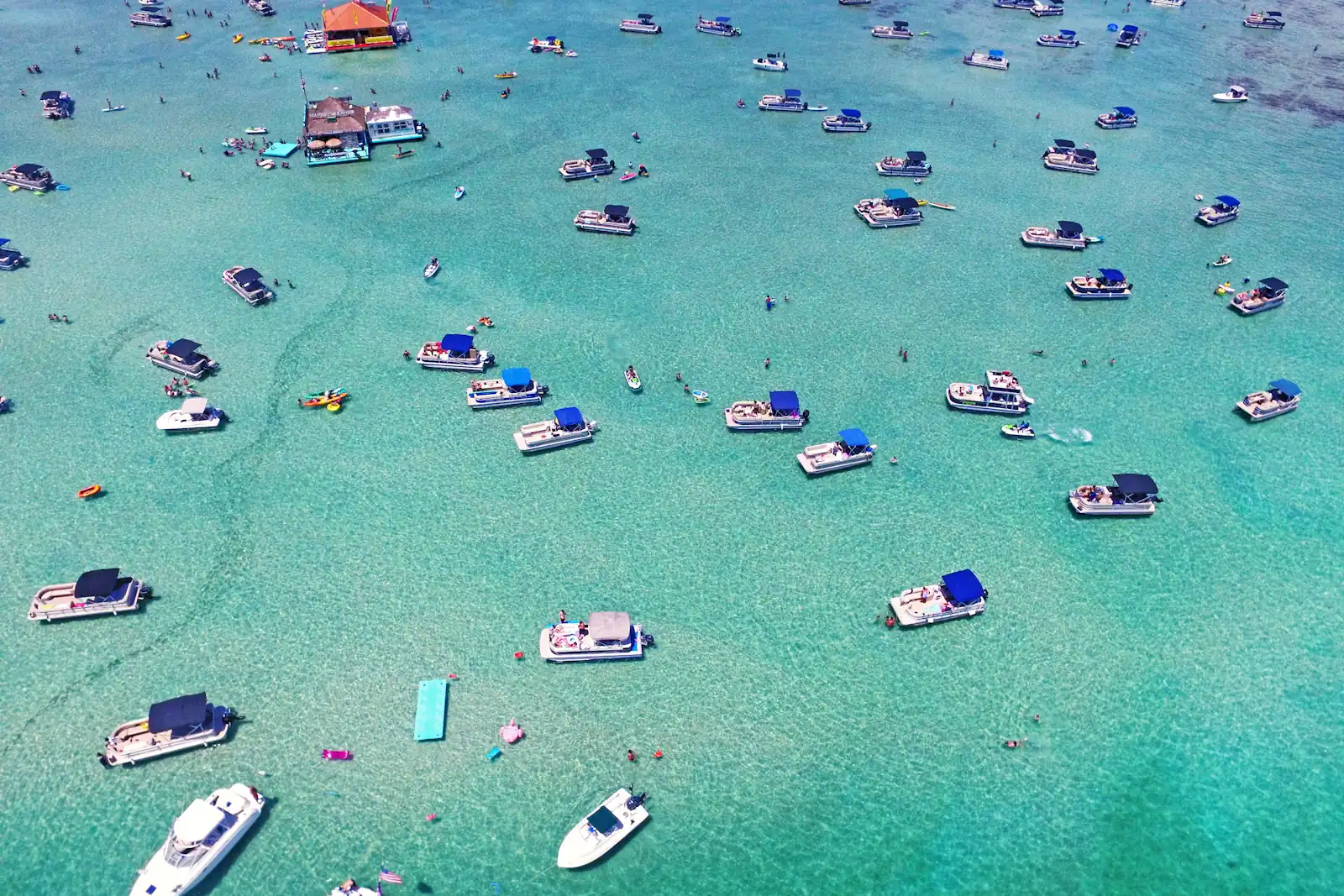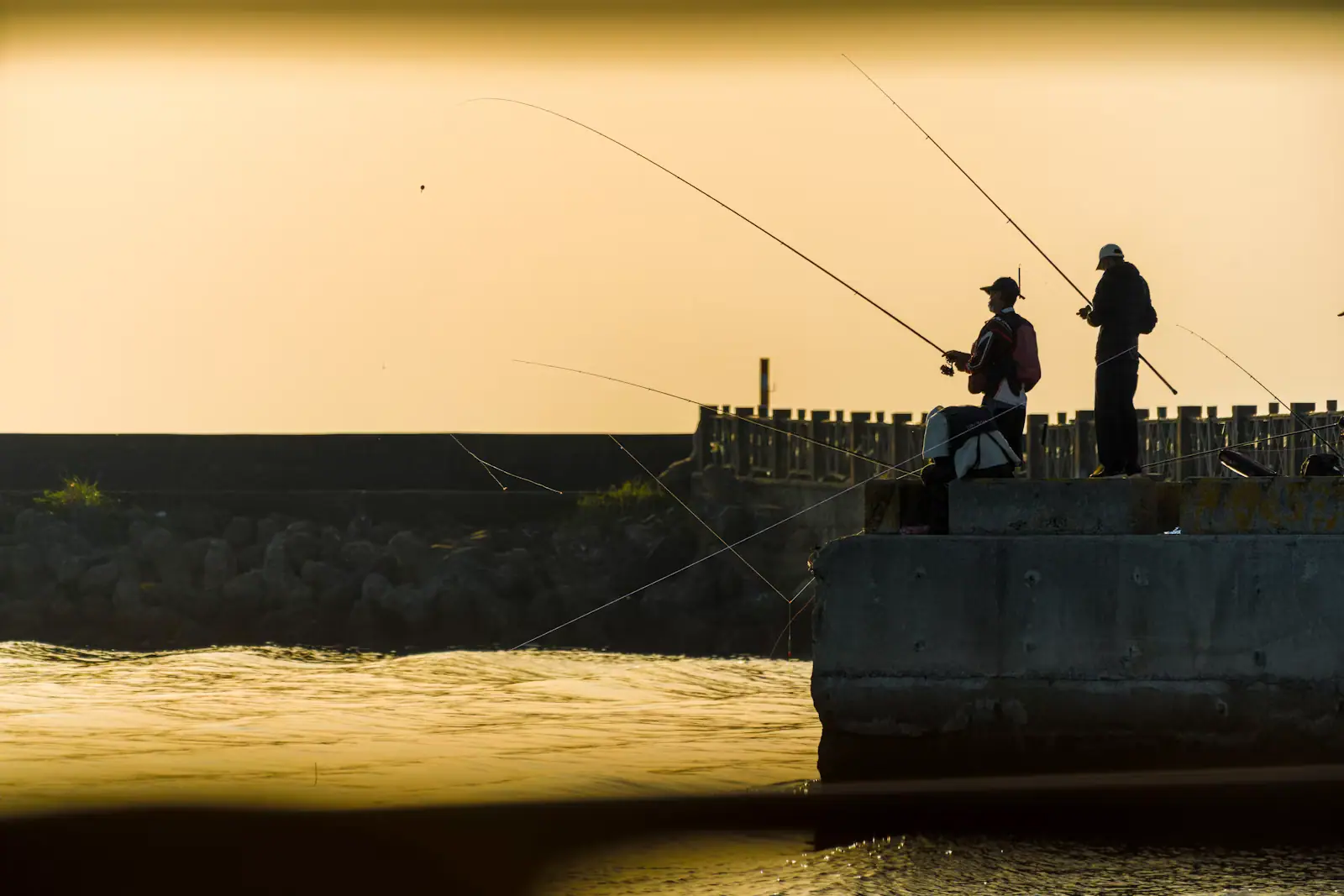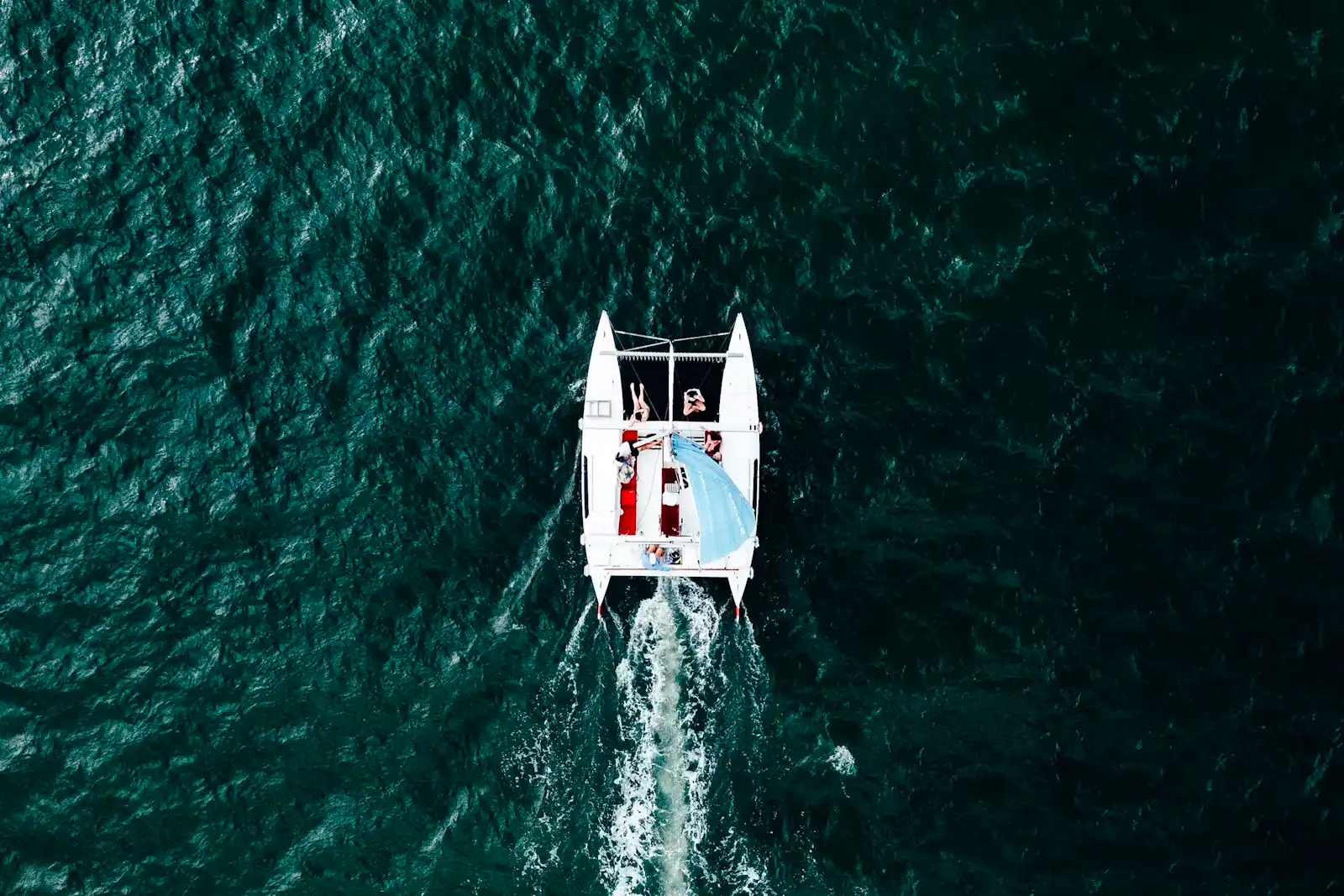
This is a boating coast in a way that most Florida beach towns are not. Choctawhatchee Bay runs roughly thirty miles east from the pass, Santa Rosa Sound runs west behind the barrier island for about as far again, and a chain of bayous branches off both. You can spend a week on the water here without repeating a day, and most visitors use a rental boat for exactly one afternoon at a sandbar.
Which boat for which day
| Boat | Typical day rate band | Carries | What it is for |
|---|---|---|---|
| Pontoon, 20–22 ft | Half day roughly $350–500, full day roughly $550–750 | 8–11 | Sandbars, the sound, cruising with a cooler |
| Double-deck pontoon with slide | Meaningfully higher than a standard pontoon | 12–14 | Teenagers, a long day, a group photo |
| Tri-toon with a larger engine | Above a standard pontoon | 10–13 | Crossing open bay in chop, longer runs |
| Deck boat / bowrider | Similar to a mid pontoon | 6–8 | Speed, tubing, getting somewhere |
| Centre console | Varies widely | 4–6 | Fishing the bay, the pass on a calm day |
| Jet ski | Roughly $100–120 the first hour | 2–3 | An hour of noise, not a day out |
| Captained charter | From several hundred, rising with size | Varies | No licence needed, no anchoring decisions |
Those bands were what published 2026 rate cards looked like across Destin and Okaloosa Island operators. They move with season and boat size, and the advertised number is rarely the total. Three questions to ask before paying: is fuel included or charged on return, is there a damage waiver or a held card deposit, and is there a fee for a second named driver.
If you are on the fence between a pontoon and a deck boat, pick on wind rather than on price. A flat-fronted pontoon is a comfortable platform on flat water and a wet, slow, slamming one in a short bay chop. On a breezy day the tri-toon or a deck boat with a V is worth the difference.
The licence question
The cut-off is a date of birth of 1 January 1988 or later. Anybody on that side of the line needs Florida's Boating Safety Education Identification Card before taking the helm of anything making 10 horsepower or more, and rentals are not exempt. The card does not expire, and it is not a licence in the driving sense: it certifies a course, not a test of your handling.
If you do not have one, an approved online course issues a temporary certificate valid for 90 days the moment you pass a 25-question exam requiring 19 correct answers. Do it before you travel, print it, and bring photo ID. Rental desks differ in how much help they will offer on the morning, and the worst version of this is a group standing on a dock at 9am discovering that the only certified adult is the one who gets seasick.
Renting a captained boat removes the requirement entirely, which is a legitimate reason to choose one.
Where to pick the boat up
Destin Harbor. The biggest concentration of rental and charter operators, and the shortest run to Crab Island and East Pass. It is also the busiest water in the county, and the harbour is idle-speed for its full length, so budget ten minutes just getting out of it in July.
Okaloosa Island. Fewer operators, easier parking, and you start in Santa Rosa Sound. Crab Island is ten to twenty minutes east under the Brooks Bridge.
Mainland Fort Walton Beach. Sound-side rentals and the public ramp at Liza Jackson Park, which has two lanes and is open around the clock. Best if the sound and the bayous are the plan rather than the sandbar.
Niceville and the bayous. Quietest launch on this side of the bay, with a ramp inside Fred Gannon Rocky Bayou State Park. It puts you at the wrong end of the bay for Crab Island and the right end for fishing.
The three pieces of water to respect
East Pass. The pass connects Choctawhatchee Bay to the Gulf at Destin and it is the most serious water in the county. An outgoing tide pushing against a southerly wind stands the waves up in the throat of the pass, steep, close together, and capable of taking a rental pontoon's bow under. Rental agreements routinely prohibit taking pontoons through it, and that clause exists for a reason. If you want to go outside, take a suitable hull or take a captain.
The shoals. Choctawhatchee Bay is wide and largely shallow, with sandbars that do not appear where a phone map suggests, particularly near the river mouths at the east end and along the north shore. Read the markers, not the screen. A grounding is the most common rental damage claim on this coast and the towing bill is not small.
The bay in wind. Thirty miles of fetch and shallow water make a short, steep chop very quickly, and a north wind in spring can turn a flat morning into an unpleasant afternoon by one o'clock. Check the forecast at breakfast and again before you leave the dock.
Rules that get enforced
- Life jackets for every person aboard, and worn continuously by children under six on any vessel under 26 feet while under way.
- Boating under the influence is policed here the way drink-driving is, hardest on holiday weekends. The Sheriff's marine unit and the Coast Guard station at the pass both work this water.
- Personal watercraft and motorboats must stay at least 700 feet off the Gulf shoreline.
- Idle and no-wake zones through Destin Harbor, around bridges and in the bayous. Your wake is your responsibility, including the damage it does to a moored boat.
- Stay out of the marked navigation channel when anchoring anywhere near Crab Island or the pass.
- Nothing overboard. This bay drains to the Gulf through one opening.
Bringing your own boat
Trailering here is straightforward and the ramps are decent. Liza Jackson Park in Fort Walton Beach is the practical mainland launch onto Santa Rosa Sound, with two lanes and 24-hour access; the county approved funding to renovate it, so check current status before a dawn start. Rocky Bayou State Park's ramp is the quiet option on the north side of the bay.
Two local habits worth adopting. Launch early on summer weekends: the ramps queue from about seven. And if you are running between the Gulf and the bay, do it near slack water rather than mid-ebb, whatever the weather is doing.
The ten-minute check before you sign
Rental operators here are generally good, and the handover is still where problems start. Do this before you leave the dock rather than discovering it in the bay.
- Photograph the hull, the props and the upholstery from all four sides, timestamped. Prop dings are the most disputed damage claim on this coast.
- Confirm the fuel policy out loud. Included, or metered on return at the operator's pump price? The difference on a full day can be substantial.
- Check the anchor and rode. You want more rode than you think: the bay is shallow but the tide runs, and a short scope drags into your neighbour at Crab Island.
- Test the horn, the navigation lights and the bilge pump. If your rental runs past dusk you are legally required to show lights.
- Ask where the shoals are and have them point at the chart. A local will tell you honestly and it takes a minute.
- Agree a return time with a margin. Late fees are steep, and the run home is always slower than the run out because the afternoon wind has got up.
Last updated
Opening hours, ordinances and prices move with the season. We re-check this guide rather than rewrite it, and the date above is the last time someone did. How we research and correct.