Top Shelf Tikis Crab Island Adventure 3 hr (opens in a new tab)
Set sail on a lively 3-hour Premium Tiki Boat trip to Crab Island in Destin, Florida, where adventure and relaxation await. This…
3 hours
Prices checked
Neighbourhood
Last updated
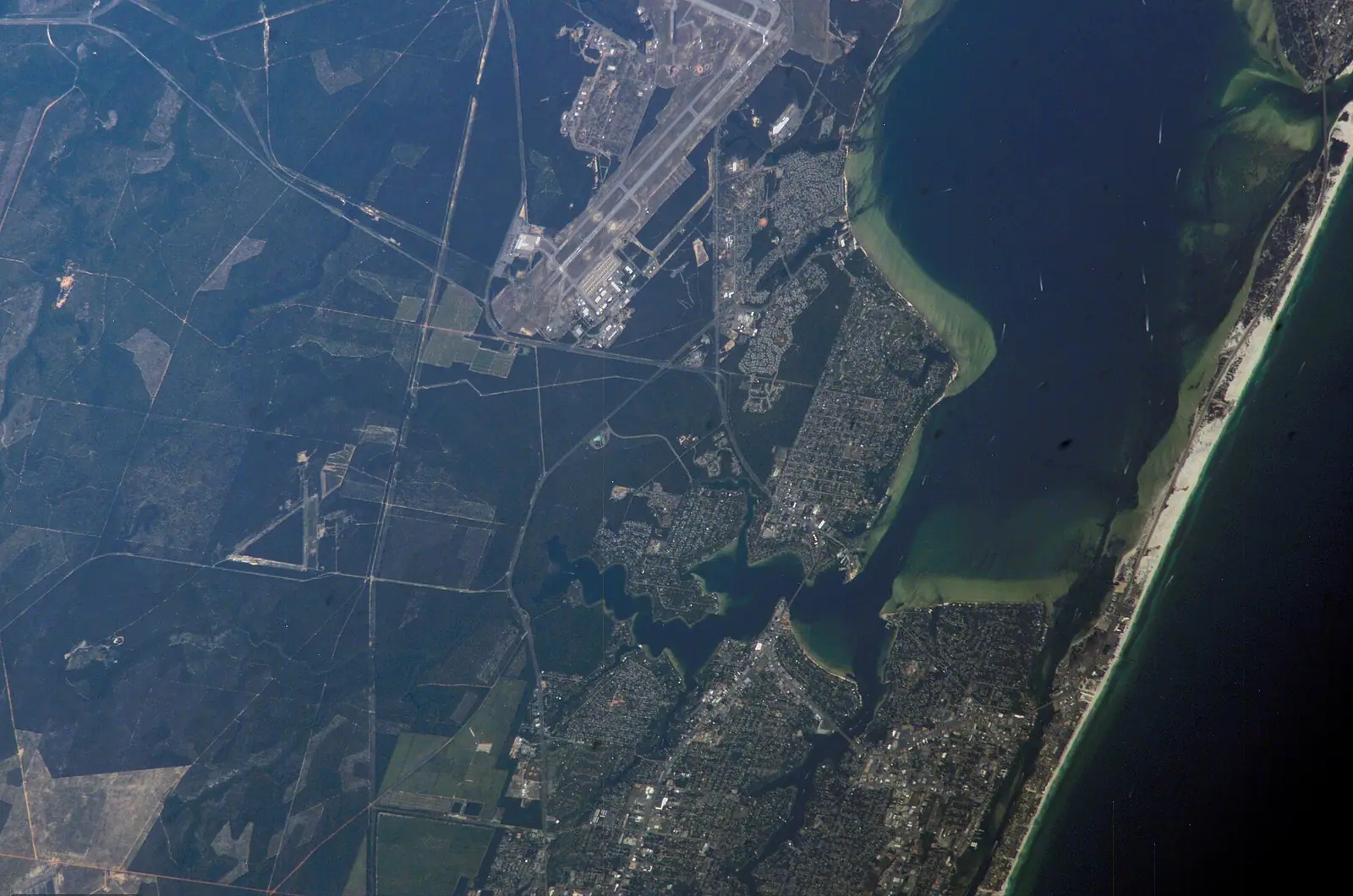
A few hundred people on a bayou between two air bases, on ground that was chartered in 1931 to become a deep-water port.
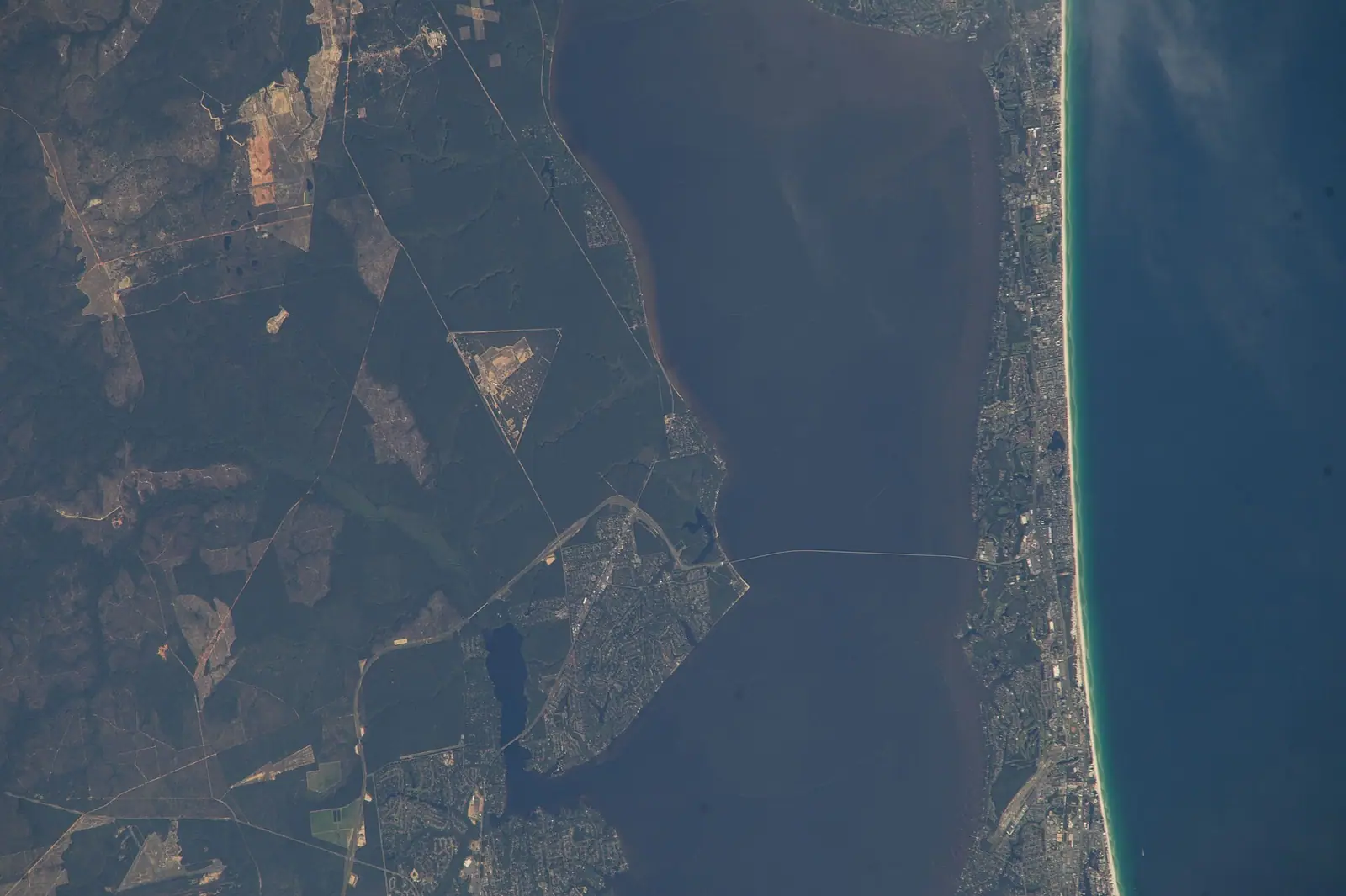
Photo: Earth Science and Remote Sensing Unit, Lyndon B. Johnson Space CenterPublic domain
Shalimar takes about ninety seconds to drive through and most visitors never register that they have. It sits on Eglin Parkway between Fort Walton Beach and Valparaiso, a grid of quiet streets running down to Garniers Bayou, with a population somewhere in the region of seven or eight hundred. It has no beach, no hotel strip and nothing that could reasonably be called an attraction.
What it has is a story that explains a good deal about this county.
In 1931 a group of developers chartered the Port Dixie Harbor and Terminal Company and announced that this bayou would become a commercial and industrial complex: deep water, large vessels, a supporting railroad, the works. Panhandle Florida had watched Pensacola and Panama City build port economies and there was no obvious reason this shoreline could not do the same. The timing was catastrophic. The crash of 1929 and the Depression that followed killed Port Dixie before anything substantial was built, and the bayou stayed a bayou.
What arrived instead was the Air Force. In the 1940s the developer Clifford Meigs built around a hundred and sixty houses here specifically for officers stationed at Eglin, and that single decision set the character of the place for the next eighty years. The town incorporated in 1947, in accounts tied up with preserving the Shalimar Club, a venue remembered locally for its nightlife and its gambling, which is a more interesting founding motive than most Florida municipalities can claim.
The name is glossed here as meaning something like "by the beautiful water", though the derivation is argued over.
For a visitor, the honest position is this: Shalimar is worth five minutes of your attention as you drive between the coast and Niceville, and it is worth understanding as the clearest example of how a working military base built a county.
North out of Fort Walton Beach on Eglin Parkway (SR 85), about ten minutes from downtown. Shalimar runs along the parkway between Fort Walton Beach and Valparaiso, with the residential streets and the bayou on the eastern side.
From Okaloosa Island, add the Brooks Bridge crossing and allow twenty minutes outside season.
Continuing north on the same road takes you past Eglin's main gate and the Air Force Armament Museum, then on to Valparaiso and Niceville, which makes Shalimar a natural first two minutes of an inland afternoon rather than a destination in itself.
There is no public transport that would make sense for a visitor, and nothing in the town requires a car park, because there is nothing in the town that requires stopping. Pull over on a residential street to look at the bayou and nobody will mind.
Stand at the water's edge on Garniers Bayou and the Port Dixie plan looks absurd, which is exactly why it is worth knowing about.
The bayou is a sheltered arm off the western end of Choctawhatchee Bay. Sheltered is the operative word: it is shallow, it is narrow, and the only route to the Gulf from any of it runs the length of the bay and out through the pass at Destin, which in 1931 was a shifting cut of uncertain depth that had only existed for a couple of years. Any serious cargo vessel would have had to negotiate all of that before it got anywhere near a wharf.
The promoters were undeterred. A harbour and terminal company was chartered, a railroad was drawn onto the plan, and lots were marketed. Then the Depression removed the capital and the whole thing evaporated.
It is a useful corrective to the way Florida history is usually told. The Panhandle in the 1920s was full of confident schemes, and most of them ended in a plat map and nothing else. What actually built this coast was not private enterprise at all; it was a federal decision to turn a national forest into a bombing range.
There is no monument and nothing to photograph. The evidence is simply that a town of seven hundred people occupies ground that somebody once expected to carry a railway.
The houses Clifford Meigs put up in the 1940s were built for a specific customer: an Air Force officer posted to Eglin, wanting a decent family house within a short drive of the gate, in a place where none existed.
That is still what Shalimar is. Drive the residential streets and the pattern is obvious — modest mid-century houses on generous lots, a lot of them extended and updated, running down towards the water on the bayou side. Many are occupied by retired officers who were posted here once, liked it, and came back. Others turn over every two or three years as families arrive on orders and leave on the next set.
The result is a town with an unusual demographic profile for a place its size: high proportion of veterans, high proportion of people who have lived somewhere else recently, and a rate of engineering and technical employment that has nothing to do with tourism.
For a visitor this is the interesting part. Almost every American beach destination presents itself as a holiday and conceals the economy underneath. Here the economy is the point and the holiday is a side effect, and driving through Shalimar for five minutes makes that visible in a way that a brochure cannot.
Very little, and it would be dishonest to pretend otherwise.
There is no public beach in Shalimar. There is no visitor centre, no museum, no boardwalk, and no shopping district worth the detour. The waterfront is residential and largely private, on Garniers Bayou, Hand Cove, Paquito Bayou and Lake Lorraine.
What is genuinely worth doing:
Drive it on the way north. If you are heading from Fort Walton Beach to Niceville, Rocky Bayou State Park or the Mid-Bay Bridge, Eglin Parkway takes you through Shalimar and Valparaiso and shows you a side of Okaloosa County that US 98 hides entirely.
Look at the water. The bayou is flat, green and lined with pines and docks rather than condominium towers, and it is the closest thing this county has to a Lowcountry creek.
Eat here rather than on the strip. The restaurants that serve towns like this one serve the people who live in them, which usually means better value and shorter queues than the beach road. Nothing is named here because small-town businesses on this coast open and close faster than a guide can track.
Fifteen minutes. That is the honest budget, and it is fifteen minutes better spent than the equivalent stretch of US 98.
Operators run these trips past Shalimar, or stop there as part of a longer route. We list what the booking data supports — not everything that mentions the name.
We take a commission on these bookings through Viator. You pay the same, and the commission did not pick the list.

Set sail on a lively 3-hour Premium Tiki Boat trip to Crab Island in Destin, Florida, where adventure and relaxation await. This…
3 hours
Prices checked

Our product is unique because of how easy it is to walk around and see over the side of the boat. Our boat is stable open air with a…
1–2 hours
Prices checked

Tour Highlights: 1. Crab Island Exploration: This submerged sandbar is renowned for its crystal-clear emerald waters (at high tide as…
3 hours
Prices checked

Experience the thrill of dolphin-watching with Hydrojet on an excursion that navigates Crab Island, showcases a scenic cruise of Destin…
1 hour
Prices checked

Come join us on the water, create memories and photo ops that will last a lifetime on the most photographed vessel in the harbor in the…
3 hours
Prices checked

Experience Crab Island on a small-group Destin boat tour limited to just 6 guests. Unlike crowded party boats, this intimate charter…
3 hours
Prices checked
Straight-line distances, so allow more on the road — the island is long and has one main parkway.

The county's inland town, with a boardwalk over a creek clear enough to swim in and a name it chose in 1910 to stop being called Boggy.
2–5 hoursFree to visit. The Turkey Creek boardwalk costs nothing; theatre tickets and state park entry are separate.7.6 mi away
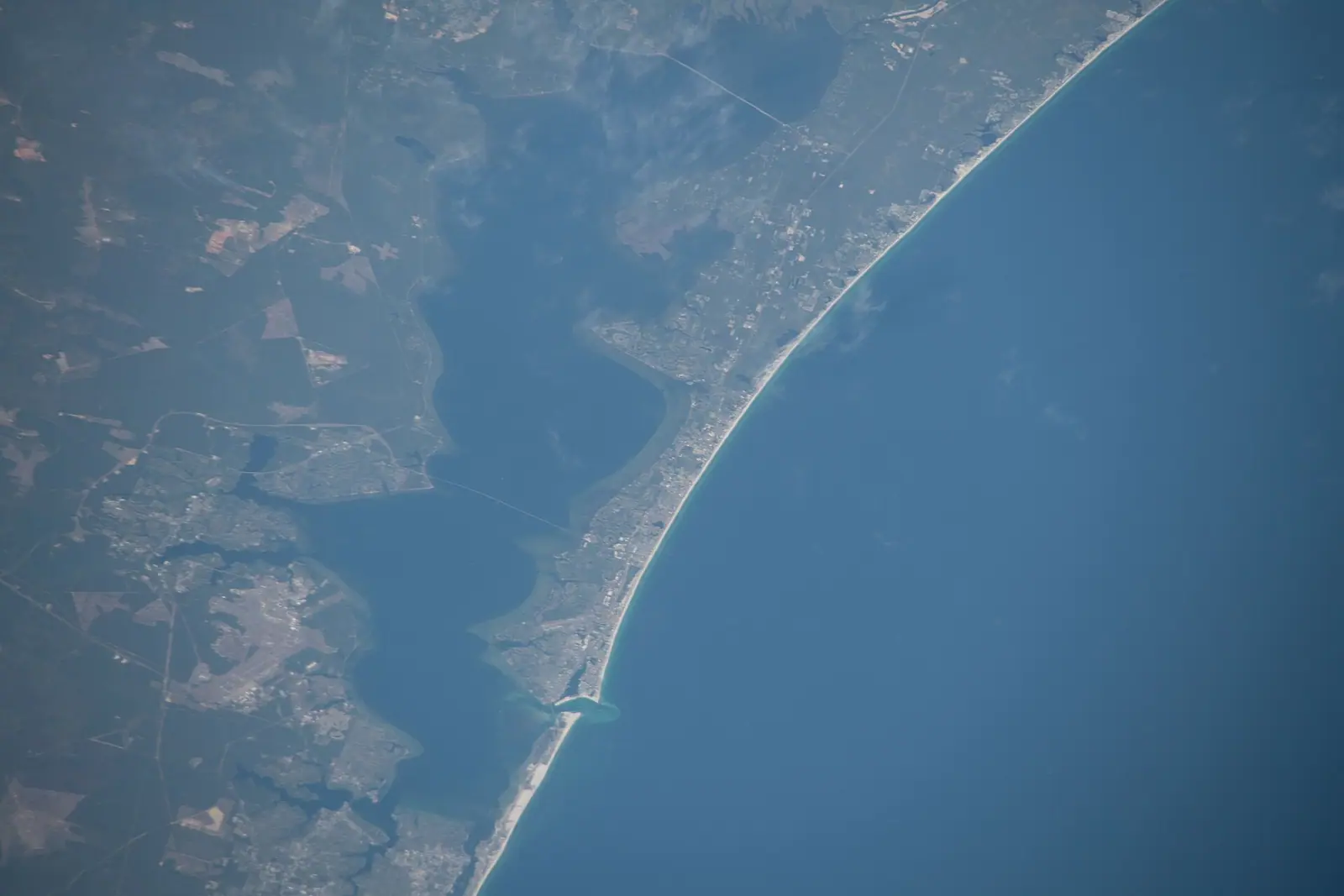
Photograph: Earth Science and Remote Sensing Unit, Lyndon B. Johnson Space Center

463,128 acres of pine and test range behind the beach: a free museum outside the gate, and a permit for walking any of the rest.
1.5–8 hoursThe Air Force Armament Museum is free. Recreational access to the reservation requires an inexpensive Eglin permit.4.1 mi away
Photograph: Unknown authorUnknown author

Twenty-seven miles of near-tideless brackish water with one narrow way out to the Gulf, which is why everything on this coast floats on it.
2–8 hoursFree to be on. The Mid-Bay Bridge is tolled, and boat rental, fuel and launch ramps are separate costs.13.5 mi away
Photograph: Earth Science and Remote Sensing Unit, NASA Johnson Space Center

Three easy loops through 300-year-old longleaf pine on a bayou shore that the Air Force used as a gunnery range before it was a park.
1.5–5 hoursA small per-vehicle entry fee, published at around $5, paid at the ranger station or honour box.9.7 mi away
Photograph: Dane314pizza
Where this place fits into a day, and the pages that plan one.

An attraction in this town is usually a landform. There is no theme park on the mainland, no aquarium chain, no historic district of restored…

Most beach towns have a military base somewhere nearby. Fort Walton Beach is the other way round: the base has a beach town attached to it. Eglin…
Photograph: Unsplash

Work out what a week on a Florida beach island usually costs you before you have bought anything, and the number is mostly parking. Metered lots…
Photograph: Unsplash

US 98 is the spine, the only spine, and it crosses water three times between Pensacola and Panama City. Understanding that one fact explains almost every delay you will have here.
7 min readTamika Rowe
Photograph: Unsplash

One of the largest military installations on earth sits behind this town, and the reason the beach road was ever paved. Most of it is closed. The best parts are free.
7 min readShelby Duval
Photograph: Unsplash
For about fifteen minutes, on the way to somewhere else. Shalimar is a residential town of seven or eight hundred people on Garniers Bayou with no public beach, no museum and no shopping district. What it offers is a quiet bayou shoreline and a clear view of how the Air Force built this county, which is more than the equivalent stretch of US 98 gives you. Do not plan a day around it.
The name is glossed locally as meaning something like by the beautiful water, though the derivation is argued over and the town's own accounts differ from popular ones. What is better documented is what the name replaced: in 1931 this ground was promoted as Port Dixie, the site of a chartered harbour and terminal company that was supposed to bring deep-water shipping and a railroad to Garnier's Bayou before the Depression ended it.
Shalimar exists in its present form because of Eglin. In the 1940s the developer Clifford Meigs built around a hundred and sixty houses here specifically for officers stationed at the base, and the town incorporated in 1947. Eighty years later the demographics still show it: a high proportion of veterans, a steady turnover of families arriving and leaving on orders, and technical employment that has nothing to do with tourism.
No. Shalimar sits on Garniers Bayou, an arm of Choctawhatchee Bay, and its waterfront is residential and largely private. The nearest public swimming water is Liza Jackson Park on Santa Rosa Sound, about ten minutes south in Fort Walton Beach, and the nearest Gulf beaches are on Okaloosa Island, twenty minutes away across Brooks Bridge. Do not treat a dock or a waterfront lawn here as public access.